Italy offers an extraordinary variety of travel experiences within one country. Ancient ruins, Renaissance cities, Alpine mountains, Mediterranean islands, vineyards, lakes, beaches, and historic villages can all become part of the same trip.
Choosing the Best Places to Visit in Italy depends on what kind of traveler you are. First-time visitors often begin with Rome, Florence, and Venice, while travelers interested in scenery may prefer the Amalfi Coast, Tuscany, Lake Como, the Dolomites, Sicily, or Sardinia. Italy’s official tourism site highlights destinations ranging from major cities and lakes to coastal regions, mountain resorts, islands, and historic villages.
Rome
Rome is one of the best starting points for a first trip to Italy.
The city brings together ancient Roman history, Renaissance architecture, Baroque monuments, lively neighborhoods, and Vatican City.
Major landmarks include:
- The Colosseum
- Roman Forum
- Pantheon
- Trevi Fountain
- Piazza Navona
- St. Peter’s Basilica
- Vatican Museums
Rome’s historic center is included on the UNESCO World Heritage List, reflecting the extraordinary concentration of archaeological and architectural heritage within the city.
Allow at least three days if possible. Rome rewards travelers who spend time walking between major sights rather than treating each landmark as an isolated attraction.
Florence
Florence is essential for travelers interested in Renaissance art and architecture.
The city is compact enough to explore largely on foot, with many important landmarks concentrated around the historic center.
Highlights include the Cathedral of Santa Maria del Fiore, Giotto’s Campanile, Ponte Vecchio, Palazzo Vecchio, the Uffizi Gallery, and the Accademia Gallery.
Florence’s historic center has been a UNESCO World Heritage Site since 1982, and official Italian tourism information describes the city as one of the world’s great centers of Renaissance art.
Florence is also an excellent base for exploring Tuscany.
Venice
Venice is one of the most distinctive cities in Europe.
Built across a lagoon, the city is formed by islands linked through canals and bridges. Instead of ordinary streets throughout the historic center, much of daily movement happens on foot or by boat.
Popular places include:
- St. Mark’s Square
- St. Mark’s Basilica
- Doge’s Palace
- Rialto Bridge
- Grand Canal
- Murano
- Burano
Official Italian tourism information describes Venice as being formed from 118 islands connected by more than 400 bridges. Venice and its Lagoon are also recognized by UNESCO.
Staying overnight can provide a very different experience from visiting only during the busiest daytime hours.
Tuscany
Tuscany is one of the best regions for travelers who want countryside, historic towns, food, and wine in the same trip.
Florence may be the region’s most famous city, but Tuscany also includes places such as Siena, San Gimignano, Lucca, Pienza, and the Val d’Orcia.
The countryside is known for rolling hills, vineyards, olive groves, cypress-lined roads, farmhouses, and medieval hill towns.
A rental car can be useful for exploring rural areas, especially if you want to visit several smaller towns rather than staying only in Florence.
Tuscany works particularly well for travelers who prefer a slower itinerary.
Amalfi Coast
The Amalfi Coast is one of southern Italy’s most dramatic landscapes.
The coastline is characterized by steep cliffs, Mediterranean vegetation, small bays, terraced slopes, and towns built into the mountainsides.
Popular stops include:
- Positano
- Amalfi
- Ravello
- Praiano
- Maiori
- Minori
The Amalfi Coast has been a UNESCO World Heritage Site since 1997 and is recognized for the cultural and natural value of its Mediterranean landscape.
Travelers can combine the coast with Naples, Pompeii, Sorrento, or Capri.
Cinque Terre
Cinque Terre is a collection of five coastal villages in Liguria:
Monterosso al Mare, Vernazza, Corniglia, Manarola, and Riomaggiore.
The villages sit along a steep coastline where colorful buildings, vineyards, cliffs, and the Ligurian Sea create one of northern Italy’s most recognizable landscapes.
Walking trails connect parts of the region, while regional trains make it relatively easy to travel between the villages.
Italy’s tourism authority highlights both the hiking routes and rail connections through Cinque Terre, which has formed part of a UNESCO-listed cultural landscape since 1997.
It is especially attractive to travelers who enjoy coastal walking and smaller towns.
Lake Como
Lake Como is one of Italy’s most famous lake destinations.
Located in Lombardy, it combines Alpine scenery with elegant villas, historic gardens, waterfront towns, and ferry routes.
Popular towns include:
- Bellagio
- Varenna
- Como
- Menaggio
Official Italian tourism information highlights Lake Como among the country’s major natural destinations.
Rather than trying to visit every lakeside town, choose one or two bases and use ferries to explore nearby areas.
Lake Como is easy to combine with Milan or a broader northern Italy itinerary.
The Dolomites
The Dolomites offer one of the strongest contrasts to Italy’s famous cities and Mediterranean coastlines.
Located in northeastern Italy, these mountains are known for dramatic pale rock peaks, alpine meadows, high mountain passes, hiking routes, and ski resorts.
Popular bases include Cortina d’Ampezzo and towns across South Tyrol and Trentino.
Italy’s official tourism site highlights the Dolomites for hiking, winter sports, villages, and alpine scenery, while UNESCO recognizes the mountain range for its exceptional landscape and geological importance.
Summer is ideal for hiking, while winter is best for skiing and snow-based activities.
Sicily
Sicily is a strong choice for travelers who want beaches, history, food, cities, and archaeological sites in one destination.
Important places include:
- Palermo
- Catania
- Taormina
- Syracuse
- Mount Etna
- Agrigento
- Noto
Sicily reflects centuries of Greek, Roman, Arab, Norman, Spanish, and Italian influence.
Italy’s tourism authority describes the island as a destination combining art, cultural heritage, mountain landscapes, and the sea.
Because Sicily is large, it is better to focus on one part of the island during a short trip rather than attempting to see everything.
Sardinia
Sardinia is one of the best Italian destinations for beaches and coastal landscapes.
The island is known for clear water, granite formations, white-sand beaches, Mediterranean vegetation, and archaeological remains associated with the ancient Nuragic civilization.
Costa Smeralda is internationally famous, but the island contains many quieter coastal areas as well.
Official tourism information describes Sardinia as a destination combining beaches, unspoiled nature, archaeological heritage, and long-established local traditions.
Sardinia works particularly well for a longer summer trip centered on the sea and outdoor activities.
Puglia
Puglia occupies the heel of Italy and offers a mixture of historic towns, beaches, countryside, and distinctive architecture.
Popular destinations include:
- Alberobello
- Ostuni
- Lecce
- Bari
- Polignano a Mare
- Monopoli
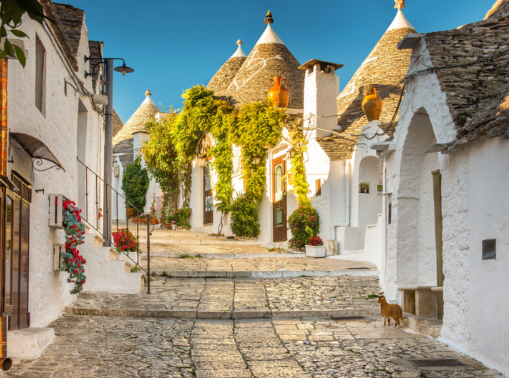
Alberobello is particularly famous for its trulli, traditional stone buildings with conical roofs. The Trulli of Alberobello are included on the UNESCO World Heritage List.
Italy’s tourism authority highlights Puglia for its coastline, historic sites, landscapes, and characteristic towns.
It is a good alternative for travelers who want southern Italy without focusing entirely on the Amalfi Coast.
Matera
Matera in Basilicata is one of Italy’s most unusual historic destinations.
The city is famous for the Sassi, ancient districts containing homes, churches, and other structures built into or around natural rock formations.
The Sassi and the Park of the Rupestrian Churches of Matera are recognized as a UNESCO World Heritage Site.
Matera works especially well as part of a southern Italy road trip combined with Puglia.
Its stone architecture and dramatic landscape create an atmosphere very different from Rome, Florence, or Venice.
Bologna
Bologna is an excellent choice for travelers especially interested in food.
The city is known for historic porticoes, medieval architecture, lively streets, and the culinary traditions of Emilia-Romagna.
Traditional regional foods include fresh pasta, ragù, tortellini, Parmigiano Reggiano, and cured meats.
Italy’s official tourism authority describes Bologna as a city combining culture, history, music, and traditional food.
Its central location also makes it a convenient stop between Florence, Venice, and Milan.
Which Places Should First-Time Visitors Choose?
For a first trip of about one week, a classic route is:
Rome → Florence → Venice
These three cities provide an introduction to ancient history, Renaissance art, and one of Europe’s most distinctive urban landscapes.
With ten days or more, consider adding Tuscany, Bologna, Naples, or the Amalfi Coast.
For two weeks, you can combine several regions without making the trip feel excessively rushed.
Travelers focused on nature may prefer Lake Como and the Dolomites, while beach-focused trips are better suited to Sardinia, Sicily, Puglia, or the Amalfi Coast.
Choosing the Best Places to Visit in Italy
There is no single list of the Best Places to Visit in Italy that works for every traveler.
Rome is ideal for ancient history, Florence for Renaissance art, Venice for unique urban scenery, and Tuscany for countryside and small towns. The Amalfi Coast and Cinque Terre offer dramatic coastlines, while Lake Como and the Dolomites showcase northern Italy’s lakes and mountains.
Farther south, Sicily, Sardinia, Puglia, and Matera provide very different combinations of beaches, archaeology, food, and regional culture.
Instead of trying to see the entire country in one trip, choose a few destinations that fit your interests and spend enough time in each place to experience more than the major landmarks. Italy’s greatest appeal lies not only in the number of famous places it contains, but in how different those places can feel from one another.